AI Impact on Jobs in Ireland: What the 2026 Research Actually Says
Research from the ESRI and the Department of Finance suggests around 7% of Irish jobs could be displaced by AI in the short to medium term, and unusually, it is graduates and higher earners who are most exposed. Here is what the evidence says, and what to do about it.
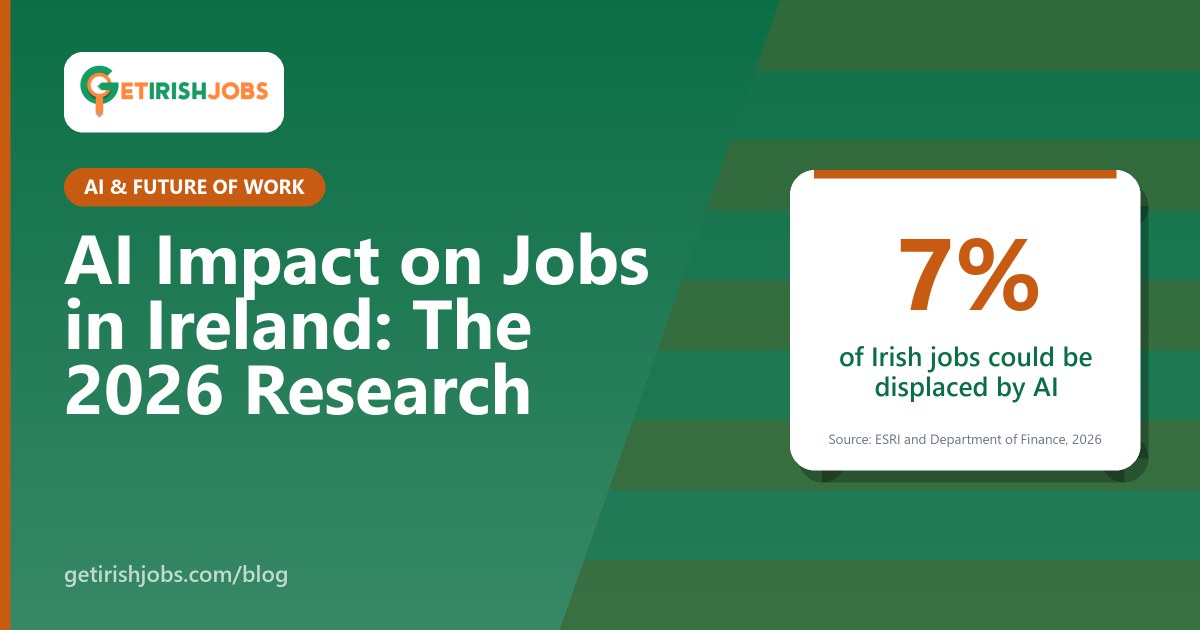
Table of contents
Last reviewed: 18 October 2026
Short answer: the AI impact on jobs in Ireland is real but narrower than the headlines suggest. In April 2026, research by the ESRI and the Department of Finance estimated that around 7% of current jobs could be displaced in the short to medium term, which is up to roughly 200,000 workers in its central scenario. Unlike earlier waves of automation, the most exposed people are highly educated, higher-earning office workers. At the same time, the share of Irish job ads asking for AI skills rose from 2.3% to 3.7% in 2025 (PwC). So AI is changing which jobs grow, not just which ones shrink.
Here's what that means for your career.
Key takeaways
- About 7% of Irish jobs could be displaced by AI in the short to medium term (ESRI and Department of Finance, April 2026).
- Exposure is highest in clerical, administrative and some ICT roles, and among graduates and higher earners.
- Job ads needing AI skills rose to 3.7% of postings in 2025, up from 2.3% in 2024 (PwC AI Jobs Barometer 2026).
- 48.4% of Ireland's working-age population was using AI tools in early 2026, one of the highest rates in the world (Microsoft).
- Unemployment was 5.0% in September 2026 (CSO), so AI isn't yet showing up as mass job losses.
How many jobs in Ireland could AI replace?
The most detailed Irish estimate comes from the ESRI report Artificial Intelligence and Income Inequality in Ireland, published on 9 April 2026 with the Department of Finance. Its central scenario suggests about 7% of current jobs could be displaced in the short to medium term. Reported in numbers, that's up to around 200,000 workers.
That's a scenario, not a forecast set in stone. The report itself depends on assumptions about how quickly Irish firms adopt AI and whether workers move into new roles. Its other key finding is that productivity gains for the workers who stay are modest at first, and that the benefits flow mostly to people who own capital. In other words, income inequality is likely to rise moderately.
Which jobs in Ireland are most exposed to AI?
The pattern in Ireland is different from the factory automation of the past. AI is good at text, numbers and code, so the jobs most exposed are office-based:
| Exposure | Examples | Why |
|---|---|---|
| Higher | General and keyboard clerks, data entry, payroll and accounts processing, basic customer support, junior content and translation | Routine, rules-based work with text and numbers |
| Mixed | Software developers, analysts, marketers, paralegals, financial services operations | AI speeds up parts of the job, but judgement and accountability stay with people |
| Lower | Nurses, carers, electricians, plumbers, construction workers, hospitality staff, teachers | Physical, hands-on or relationship-based work |
Media coverage of the research highlighted projected job losses of around 18% among general and keyboard clerks, one of the most exposed groups. Ireland's large financial services and multinational tech sectors also mean a bigger share of Irish workers do exactly the kind of desk work AI is good at.
Why are graduates more exposed than in the past?
Previous technology waves mostly hit lower-paid manual and routine jobs. Generative AI is different: it drafts reports, writes code, summarises documents and answers customer queries. Those tasks are concentrated in graduate jobs, which is why the ESRI found the share of workers moving into unemployment is substantially larger in higher-income households. Ireland has one of the highest shares of third-level graduates in the EU, so this matters more here than in many countries.
Entry-level roles are where most people feel it first. When AI handles the routine first draft, firms may hire fewer juniors. That's one reason youth unemployment was 12.5% in September 2026, more than double the overall rate, although many other factors are involved too.
Is AI creating jobs in Ireland as well?
Yes. According to PwC's 2026 AI Jobs Barometer, the share of Irish job ads requiring AI-related skills jumped by almost two-thirds in 2025, to 3.7% of postings. Ireland hosts the European headquarters of Google, Meta, Microsoft, Apple, Salesforce and many others, and these firms are hiring for AI engineering, data, cloud, security and AI governance roles.
Demand is also growing for people who can use AI well in ordinary jobs: an accountant who automates reconciliations, a recruiter who uses AI screening responsibly, or a marketer who produces more campaigns without losing quality. Irish workers are already early adopters. Microsoft's AI Diffusion Report put Ireland's AI usage at 48.4% of the working-age population in the first quarter of 2026, fourth in the world.
What does the EU AI Act mean for Irish workers?
The EU AI Act applies in Ireland. It treats AI systems used in recruitment, promotion, performance monitoring and dismissal as high-risk, which means stricter rules on transparency, human oversight and data quality as the Act's obligations phase in. For job seekers, that should mean more openness about when AI is used to screen your application. If you think an automated decision was unfair, you can ask the employer how it was made.
How can you protect your career from AI?
- List the tasks in your job and mark which ones AI could do today. Get ahead by using AI for those yourself.
- Learn the AI tools in your field. Free and subsidised options in Ireland include Springboard+ and Skillnet Ireland. See our guide to free AI courses in Ireland.
- Build skills AI can't copy: judgement, client relationships, managing people and hands-on expertise.
- Show results on your CV, for example a process you sped up with AI. Our Irish CV guide shows how.
- Look at growing sectors: healthcare, construction and housing, renewable energy, pharma and med-tech all have steady demand.
What to do next
AI won't take most Irish jobs, but it will change most of them. The people who adapt early will get the better roles. Create a free GetIrishJobs account to keep your CV ready, and browse IT and software jobs in Ireland or all the latest jobs in Ireland.
Sources
- ESRI and Department of Finance, Artificial Intelligence and Income Inequality in Ireland, 9 April 2026
- PwC, 2026 Global AI Jobs Barometer (Ireland), June 2026
- Microsoft AI Economy Institute, Global AI Diffusion Report, Q1 2026
- Central Statistics Office, Monthly Unemployment, September 2026
- Regulation (EU) 2024/1689 (EU AI Act)