Trainee Actuary Jobs in Ireland 2026: Salary, Exams and Graduate Programmes
Ireland has one of Europe's busiest actuarial job markets, built on insurance, pensions and reinsurance in Dublin. Here is what trainee actuaries earn in 2026, how the exam route works, which employers run graduate programmes and how to stand out.
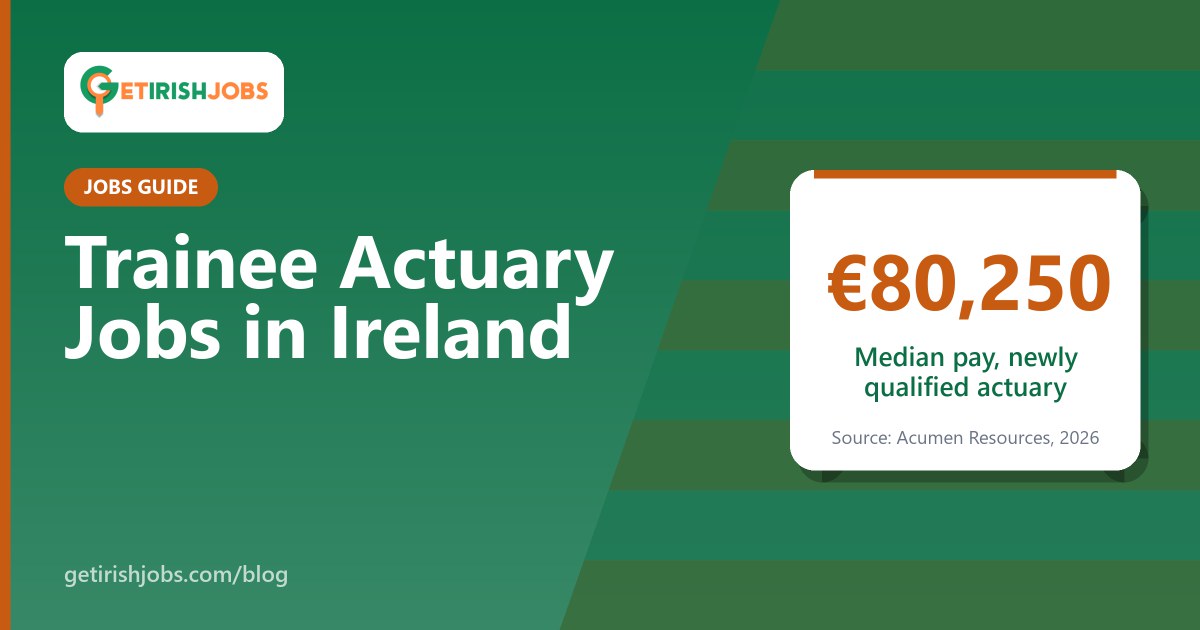
Table of contents
Last reviewed: 27 October 2026. Salary figures are survey estimates; graduate programme dates change every year.
Short answer: trainee actuary jobs in Ireland are mostly in Dublin, with life and general insurers, reinsurers, pensions consultancies and the big professional services firms. Graduates typically start on about €40,000, pay rises steadily as you pass exams, and newly qualified actuaries earn a median of about €80,000. You qualify through the Institute and Faculty of Actuaries (IFoA) exams while working, with study support from your employer.
"Trainee actuary" is a niche search, but an interesting one. It's one of the few graduate careers in Ireland with a clear, well-paid path for people who love maths and problem solving. Here's what the job really involves.
Key takeaways
- Most trainee posts are in Dublin, with insurers, reinsurers, pensions and investment consultancies.
- Median salary for a graduate with no experience: about €39,830, rising to about €53,550 after three years.
- Newly qualified actuaries: median of about €80,250 in the first year after qualifying.
- You qualify through the IFoA exams, then join the Society of Actuaries in Ireland.
- Graduate programmes usually want a strong maths-based degree, often at least a 2:1.
What does a trainee actuary actually do?
Actuaries measure and manage financial risk: how long people live, how often claims happen, and how investments behave. As a trainee, you'll spend most of your time on:
- Pricing: working out what an insurance product should cost.
- Reserving: estimating how much money a company needs to set aside for future claims.
- Pensions: valuing pension schemes and advising trustees and employers.
- Capital and regulation: reporting under Solvency II and to the Central Bank of Ireland.
- Data and modelling: lots of Excel, often Python, R or SQL, and specialist actuarial software.
Expect plenty of spreadsheets in your first year, but also real responsibility sooner than you might think. Trainees often rotate between teams every year or two.
Who hires trainee actuaries in Ireland?
Dublin is a European hub for insurance, reinsurance and fund management, which creates steady demand. Recent graduate and trainee programmes in Ireland have been run by:
- Life insurers and pensions providers, such as Irish Life and New Ireland Assurance.
- General and composite insurers, such as Aviva.
- Reinsurers, such as Munich Re, plus the many reinsurance firms based in the IFSC.
- Consultancies, such as WTW and Aon, advising on pensions and insurance.
- The Big Four and other advisory firms, with actuarial and risk teams.
Most actuarial vacancies on GetIrishJobs are in Dublin, with a few in the regions.
How much do trainee actuaries earn?
| Stage | Median salary in Ireland |
|---|---|
| Graduate, no experience | €39,830 |
| After 1 year | €43,450 |
| After 2 years | €50,000 |
| After 3 years | €53,550 |
| Newly qualified (first year) | €80,250 |
Source: Acumen Resources Actuarial Salary Guide Ireland 2026 (805 respondents). Morgan McKinley's 2026 guide puts part-qualified actuaries with up to three years' experience at €45,000–€55,000.
On top of salary, employers usually pay your exam fees, give paid study leave, and often give a pay rise or bonus for each exam you pass. That support is worth thousands of euro a year, so check it closely when comparing offers. To see what these salaries mean in your pocket, use our take-home pay guide.
How do you qualify as an actuary in Ireland?
The Society of Actuaries in Ireland (SAI) is the professional body here, but it doesn't run its own exams. Most actuaries in Ireland qualify through the Institute and Faculty of Actuaries (IFoA), which is based in the UK. The usual route is:
- Join the IFoA as a student, usually once you start your first actuarial job.
- Join the SAI as a student member once you have your IFoA reference number.
- Work through the exams while working, with study leave from your employer. Exemptions are available for some accredited university degrees.
- Complete the professionalism and work-based requirements, then become a Fellow.
Qualifying takes several years, and the exams are hard. Pass rates are lower than most people expect, and evenings and weekends of study are normal. That's the trade-off for the salary jump when you qualify.
How to get a trainee actuary job
- Apply early. Graduate programmes often open in the autumn, almost a year before the start date, and close by late autumn or winter.
- Show your maths, and your communication. Employers want strong numbers people who can explain results to non-actuaries.
- Mention any exams or exemptions you already have, and any Excel, Python or R work.
- Practise numerical and situational tests. Most graduate programmes use online assessments.
- Keep your CV to two pages. See our Irish CV format guide.
From outside the EU? Actuarial roles can qualify for an employment permit, but trainee salaries must meet the threshold, which from 1 March 2026 starts at €36,848 for recent graduates on the Critical Skills route and is higher for most other applicants. Read our guide to jobs in Ireland for foreigners.
Find trainee actuary jobs
Browse finance and actuarial jobs in Ireland, insurance jobs, or all jobs in Dublin. Create a free account to set up alerts for new actuarial roles.
Sources
- Acumen Resources, Actuarial Salary Guide Ireland 2026
- Morgan McKinley Ireland salary guide 2026 (part-qualified actuaries)
- Society of Actuaries in Ireland, "How do I become one?" and Guide for Student Actuaries
- Graduate programme listings from Irish insurers, reinsurers and consultancies, 2026