Take-Home Pay in Ireland 2027: Income Tax, USC and PRSI After Budget 2027
Budget 2027 widened the standard rate tax band to €46,500, raised the main tax credits to €2,125 and lifted the 2% USC band. Here is how income tax, USC and PRSI work in Ireland, and what you will actually take home in 2027 on different salaries.
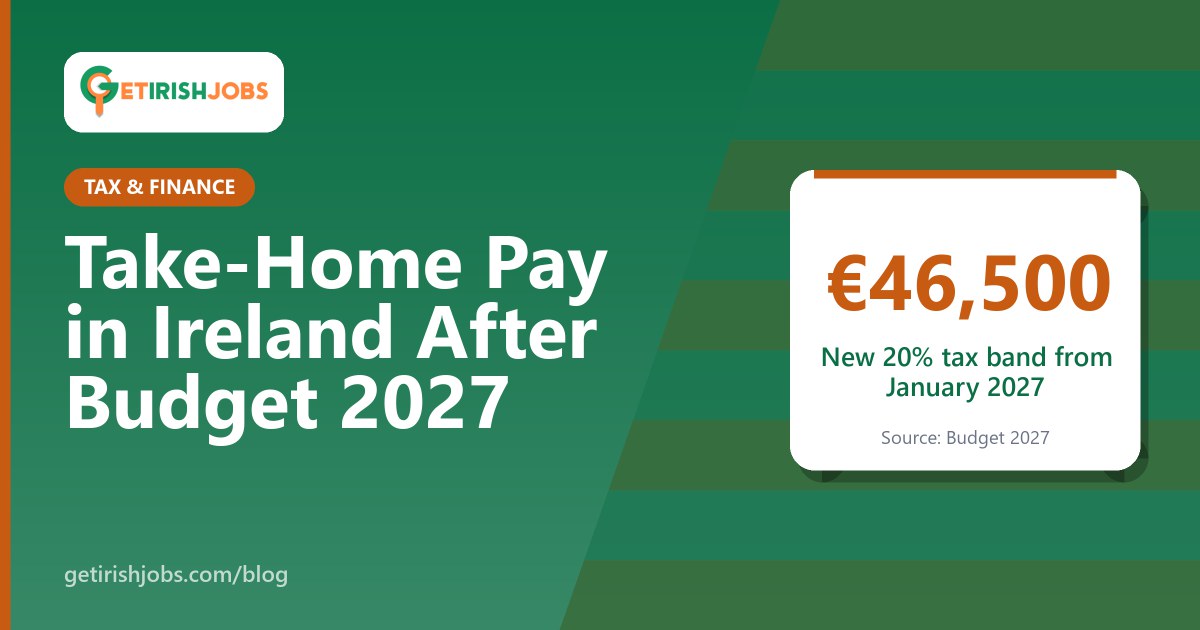
Table of contents
Last reviewed: 18 October 2026. Figures are for a single PAYE employee with no other credits or reliefs.
Short answer: your take-home pay in Ireland is your gross salary minus income tax, the Universal Social Charge (USC) and PRSI. From 1 January 2027, Budget 2027 raises the 20% tax band for a single person to €46,500, lifts the personal and employee tax credits to €2,125 each, and extends the 2% USC band to €30,300. A single worker on €50,000 pays about €766 less in income tax and USC, taking home roughly €40,360 a year (about €3,360 a month).
Key takeaways
- Standard rate band (single): €44,000 → €46,500 from 1 January 2027.
- Personal and employee (PAYE) tax credits: €2,000 → €2,125 each.
- USC 2% band ceiling: €28,700 → €30,300; USC rates unchanged.
- Employee PRSI rose to 4.35% on 1 October 2026 and is due to rise to 4.5% on 1 October 2027.
- Rent tax credit: €1,150 for a single person in 2027, up from €1,000.
How is take-home pay calculated in Ireland?
Three deductions come out of your pay, and your employer takes them through payroll each pay day:
- Income tax: 20% on income up to the standard rate band, and 40% above it. You then subtract your tax credits.
- USC: charged in bands on your total income, if you earn more than €13,000 a year.
- PRSI: social insurance at a flat percentage for most employees earning over €352 a week. It builds your entitlement to the State Pension and other benefits.
Income tax rates and credits for 2027
| Single person | 2026 | 2027 |
|---|---|---|
| 20% band | Up to €44,000 | Up to €46,500 |
| 40% rate | Above €44,000 | Above €46,500 |
| Personal tax credit | €2,000 | €2,125 |
| Employee (PAYE) tax credit | €2,000 | €2,125 |
| Rent tax credit | €1,000 | €1,150 |
USC rates for 2027
| Income | USC rate |
|---|---|
| First €12,012 | 0.5% |
| €12,013 – €30,300 | 2% |
| €30,301 – €70,044 | 3% |
| Above €70,044 | 8% |
You pay no USC at all if your total income is €13,000 or less. Reduced rates apply to some medical card holders and people aged 70 and over.
How much will I take home in 2027?
| Gross salary | Income tax | USC | PRSI (4.35%) | Take-home a year | A month |
|---|---|---|---|---|---|
| €30,298 (full-time minimum wage) | €1,810 | €426 | €1,318 | €26,745 | €2,229 |
| €35,000 | €2,750 | €567 | €1,523 | €30,161 | €2,513 |
| €50,000 | €6,450 | €1,017 | €2,175 | €40,358 | €3,363 |
| €70,000 | €14,450 | €1,617 | €3,045 | €50,888 | €4,241 |
Single PAYE employee, personal and employee credits only, PRSI at 4.35% for the full year. When PRSI rises to 4.5% on 1 October 2027, the €50,000 example pays about €19 more for the year.
Worked example: €50,000 in 2027
- Income tax: 20% × €46,500 = €9,300, plus 40% × €3,500 = €1,400. Total €10,700, minus €4,250 in credits = €6,450.
- USC: 0.5% × €12,012 = €60, plus 2% × €18,288 = €366, plus 3% × €19,700 = €591. Total €1,017.
- PRSI: 4.35% × €50,000 = €2,175.
- Take-home: €50,000 − €9,642 = €40,358.
In 2026, the same salary paid €7,200 in income tax and €1,033 in USC, so Budget 2027 saves this worker about €766 a year before the PRSI change.
What else can reduce my tax?
- Rent tax credit if you rent your home: claim it through myAccount on revenue.ie.
- Health expenses at 20%, including GP and some dental costs.
- Pension contributions, which get tax relief at your marginal rate within age-related limits.
- Remote working relief for some of your heating, electricity and broadband costs.
- Married couples and civil partners have a larger band and double the personal credit.
Why does my first payslip show emergency tax?
If Revenue hasn't issued your employer a Revenue Payroll Notification (RPN), you'll pay emergency tax. To fix it, register the job in myAccount on revenue.ie. If you're new to Ireland, you'll need a PPS number first. Overpaid tax is normally refunded through payroll once your record is updated.
What to do next
Check your 2027 payslips in January to make sure the new credits and bands are applied. If you're weighing up a new job, compare offers with the average salary in Ireland, and browse the latest jobs in Ireland on GetIrishJobs, including accounting and finance jobs.
Sources
- Government of Ireland, Budget 2027, 6 October 2026
- Revenue, income tax, USC and tax credit rates
- Department of Social Protection, PRSI rate changes
- Citizens Information, Budget 2027 summary
This article is general information, not tax advice. Check your own position with Revenue or a qualified tax adviser.