Job Vacancies in Ireland 2026: Where the Jobs Are and Who Is Hiring
Ireland's jobs market is still tight in 2026, with unemployment around 5%. Here is where the vacancies actually are, by sector and county, based on more than 10,000 live jobs on GetIrishJobs, and what it takes to land one.
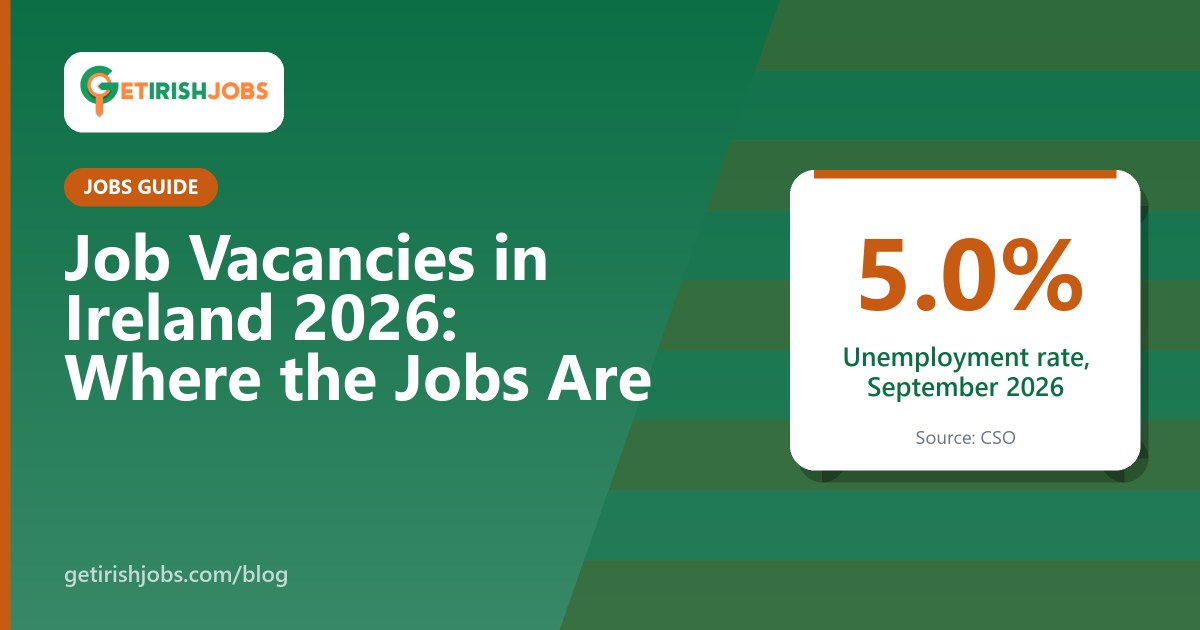
Table of contents
- How strong is the Irish jobs market right now?
- Where are the jobs? Vacancies by county
- Which sectors have the most vacancies?
- What salaries can you expect?
- When is the best time to look for a job in Ireland?
- How to stand out when you apply
- Thinking of moving to Ireland for work?
- Browse the latest vacancies
- Sources
Last reviewed: 27 October 2026. Vacancy figures are a snapshot from GetIrishJobs in mid-October 2026.
Short answer: there are plenty of job vacancies in Ireland in 2026, but they're concentrated. About seven in ten are in Dublin, and the biggest areas are management, healthcare, finance, IT and engineering. Unemployment is low, at 5.0% in September 2026, so employers compete for experienced people. Entry-level roles, though, attract a lot of applicants.
If you're searching "Irish jobs" or "Ireland job vacancy 2026", you're probably wondering two things: where is the work, and how competitive is it? Here's what the data says.
Key takeaways
- GetIrishJobs listed more than 10,000 open jobs in October 2026.
- Dublin had about 69% of them, then Cork, Galway and Limerick.
- The biggest categories: management, healthcare, accounting and finance, IT and engineering.
- Unemployment was 5.0% in September 2026, but 12.5% for people aged 15 to 24.
- The national minimum wage is €14.15 an hour from 1 January 2026.
How strong is the Irish jobs market right now?
Pretty strong, by European standards. The Central Statistics Office put the monthly unemployment rate at 5.0% in September 2026, about 149,500 people, unchanged from August. It has stayed at or below 5% every month since January 2022. For experienced workers in healthcare, tech, engineering and finance, that means choice: employers often negotiate on salary, hybrid working and benefits.
It's a different story for young people. Youth unemployment (15 to 24) was 12.5% in September. If you're starting out, expect more competition, and lean on internships, graduate programmes and part-time work to build experience.
Where are the jobs? Vacancies by county
| Location | Share of open jobs on GetIrishJobs |
|---|---|
| Dublin | About 69% |
| Cork | About 8% |
| Galway | About 4% |
| Limerick | About 3% |
| Waterford, Kerry, Kildare, Meath, Donegal, Mayo and others | The rest |
Based on more than 10,000 open jobs on GetIrishJobs, October 2026.
Dublin dominates because that's where the head offices, tech companies, banks, big hospitals and government departments are. Cork is strong in pharma, med-tech, tech and finance. Galway is Ireland's med-tech hub. Limerick has a growing base in manufacturing, tech and shared services. Outside the cities, healthcare, retail, hospitality and local government hire across every county.
Living outside Dublin can make a big difference to your budget. Many employers in Cork, Galway and Limerick pay close to Dublin rates, while rents are lower.
Which sectors have the most vacancies?
- Management: the largest category, covering project, operations, product and team leadership roles across every industry.
- Healthcare: nurses, doctors, healthcare assistants, pharmacists and allied health professionals. Public hospitals alone hire hundreds of doctors at a time; see our guide to SHO and NCHD jobs.
- Accounting and finance: from accounts assistants to financial controllers, plus fund administration, insurance and actuarial work. See our trainee actuary guide.
- IT and software: developers, data, cloud, cyber security and IT support. See our web developer jobs guide.
- Engineering: especially in pharma, med-tech, construction and energy.
Creative roles such as graphic design are smaller in number but steady. Hospitality, with roles like hotel duty manager, hires year-round, with peaks before summer and Christmas.
What salaries can you expect?
Pay depends hugely on the sector. The national minimum wage is €14.15 an hour for workers aged 20 and over, from 1 January 2026, about €28,700 a year for a full-time 39-hour week. Many professional roles pay well above that: experienced developers, engineers and doctors often earn €60,000 to €80,000 or more. For a full breakdown, read our average salary in Ireland guide, and check what you'll actually take home with our take-home pay guide.
When is the best time to look for a job in Ireland?
Ireland hires all year, but there are patterns. January and February are busy, as new budgets kick in and people move jobs after Christmas. September is another peak, after the summer slowdown. Graduate programmes usually open in the autumn, almost a year before the start date. Hospitality and retail hire ahead of summer and Christmas, and hospital doctor posts follow the January and July changeovers. The quietest stretch is usually late July and August, when many hiring managers are on holiday, though there's also less competition then.
How to stand out when you apply
- Tailor every CV. Irish recruiters skim. Put the skills from the job ad near the top. Our Irish CV format guide shows the layout employers expect.
- Apply early. Popular jobs, especially in Dublin, can close within a week or get hundreds of applications.
- Use job alerts so you see new vacancies the day they're posted.
- Be clear about your right to work. If you need a permit, say so honestly. If you already have Stamp 4 or Stamp 1G, say that up front, because it removes a big obstacle for employers.
- Follow up. A short, polite email after an interview still makes a difference.
Thinking of moving to Ireland for work?
If you're not from the EU, EEA, Switzerland or the UK, you'll need a job offer and an employment permit before you come. From 1 March 2026, that usually means a salary of at least €36,605. Our guide to jobs in Ireland for foreigners walks you through permits, visas and costs.
Browse the latest vacancies
See all jobs in Dublin, jobs in Cork or jobs in Galway, or browse by sector: healthcare, IT and accounting and finance. Create a free account to set up job alerts.
Sources
- Central Statistics Office, Monthly Unemployment September 2026
- Department of Enterprise, Tourism and Employment: national minimum wage from 1 January 2026; employment permit thresholds from 1 March 2026
- GetIrishJobs, open vacancies by county and category, October 2026