SHO Jobs in Ireland 2026: Medical Council Registration, Pay and How to Apply
Senior House Officer posts are how most international doctors start their careers in Irish hospitals. Here is how Medical Council registration and the PRES exam work, what SHOs and registrars are paid on the June 2026 HSE scales, and how to land your first post.
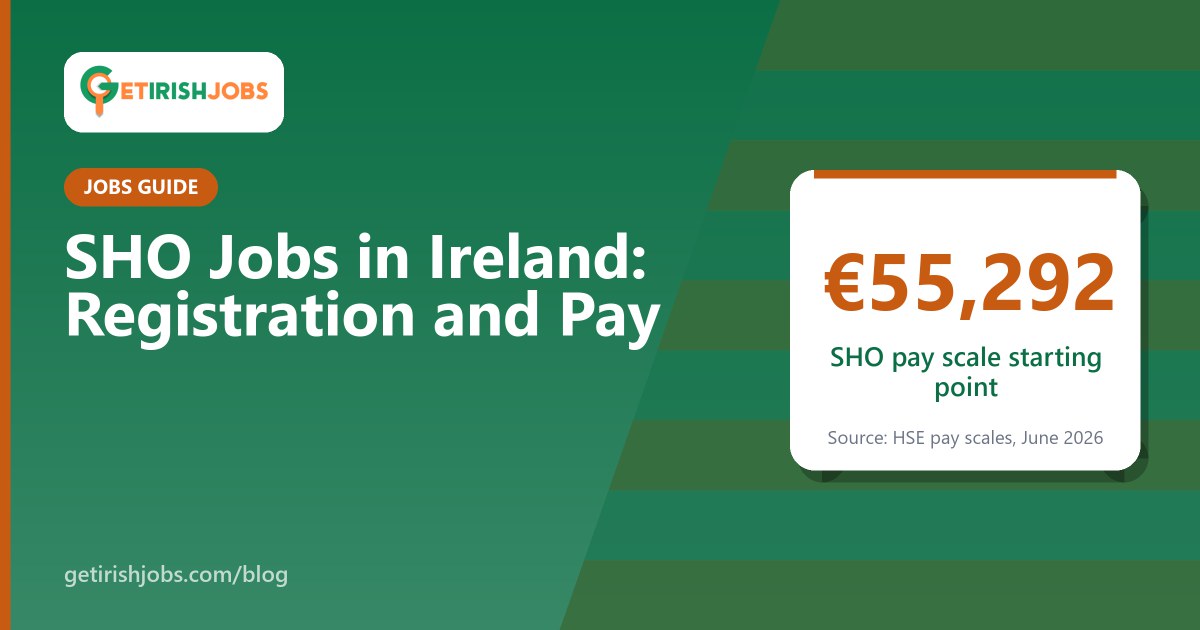
Table of contents
Last reviewed: 27 October 2026. Registration rules and fees change; always confirm with the Medical Council (IMC) and the HSE.
Short answer: to get SHO jobs in Ireland you need registration with the Irish Medical Council, which for most doctors who trained outside the EU means passing the PRES exam unless you're exempt, plus a job offer and, if you're not from the EEA, an employment permit. On the HSE scales from 1 June 2026, a Senior House Officer earns €55,292 to €75,623 a year before overtime and on-call pay.
Irish hospitals rely heavily on internationally trained doctors, and SHO posts are where most of them start. GetIrishJobs alone had more than 230 open NCHD posts in October 2026, mostly in Dublin, Cork, Galway and Waterford. Here's how to get one.
Key takeaways
- SHOs are non-consultant hospital doctors (NCHDs), the grade between intern and registrar.
- You must be registered with the Medical Council before you start, so plan for around 6 to 10 months if you need the PRES exam.
- HSE pay from 1 June 2026: SHO €55,292–€75,623, Registrar €70,276–€82,756, Specialist/Senior Registrar €83,847–€102,619.
- Most posts run for six or twelve months, with big changeovers in January and July.
- Non-EEA doctors usually work on a Critical Skills Employment Permit.
What is an SHO in Ireland?
In Irish hospitals, all doctors below consultant level are called non-consultant hospital doctors, or NCHDs. The grades run from intern (the first year after medical school), to Senior House Officer, then Registrar, and finally Specialist or Senior Registrar before consultant.
SHO posts come in two broad types. Training posts are part of a structured scheme, such as Basic Specialist Training, run through the postgraduate training bodies. Non-training or service posts are stand-alone jobs. Most international doctors start in non-training posts, gain Irish experience, and then apply for training schemes.
Step 1: Register with the Medical Council
You can't work as a doctor in Ireland without registration from the Irish Medical Council (IMC). Here's how it usually works for doctors trained outside the EU:
- Verify your credentials. Non-EEA applicants have their primary medical qualification verified through EPIC, the international credentials verification service. The IMC doesn't accept documents sent directly by applicants.
- Prove your English. Most applicants need IELTS Academic or OET results that meet the Council's standard.
- Pass the PRES exam, unless exempt. The Pre-Registration Examination System has a Level 2 written exam and a Level 3 clinical OSCE. You may be exempt if, for example, you're eligible for the Specialist Division, or you're an EU graduate with automatic recognition.
- Get registered. Many doctors are registered first in the Supervised Division, practising under supervision in an approved post, before moving to the General Division.
One important rule: graduates of medical schools outside the EU and EEA can't apply for intern posts in Ireland. That's why international doctors enter at SHO level.
Timelines vary, but doctors who need PRES should allow roughly 6 to 10 months from starting the process to starting work. Check exam dates and fees on the Medical Council's website, as they change each year.
Step 2: How much do SHOs and registrars earn?
| Grade | HSE pay scale from 1 June 2026 |
|---|---|
| Senior House Officer | €55,292 – €75,623 (7 points) |
| Registrar | €70,276 – €82,756 (6 points) |
| Specialist Registrar / Senior Registrar | €83,847 – €102,619 (7 points) |
Source: HSE consolidated pay scales, 1 June 2026. Excludes overtime and on-call payments.
You move up a point on the scale with each year of service, and your starting point depends on your previous experience. On top of basic pay, NCHDs are paid for overtime and on-call, which can add a lot, especially in busy specialties. The NCHD contract also covers allowances for things like training and exam costs. To see what these salaries mean after tax, USC and PRSI, use our take-home pay guide.
Step 3: Find a post and get your permit
Most SHO jobs are with HSE hospitals and voluntary hospitals, recruited by the hospital or hospital group. Posts usually run for six or twelve months, and most start at the January and July changeovers. Recruitment for July starts in the spring, so apply early.
If you're not from the EEA, your hospital will usually support a Critical Skills Employment Permit, as medical practitioners are on the Critical Skills Occupations List. After you arrive you'll register for an Irish Residence Permit. Our Critical Skills permit guide and our guide to jobs in Ireland for foreigners explain the steps and costs.
Tips for international doctors
- Start the IMC process before you apply. Hospitals shortlist doctors who are registered, or clearly on the way.
- Write a clinical CV, not a general one. List your specialties, rotations, procedures and audits. Our Irish CV guide covers the layout.
- Get your references ready. Irish hospitals check clinical references carefully, usually from consultants you've worked with recently.
- Be flexible on location. Hospitals outside Dublin often have more posts and less competition, and rent is cheaper.
- Think about your next step. Use your first posts to build experience and audits that strengthen a training scheme application.
Is working as an SHO in Ireland worth it?
For many international doctors, yes. You work in an English-speaking system with structured training pathways, competitive pay and a clear route towards specialist training. The workload can be heavy, and rotations mean moving every six or twelve months. Go in with realistic expectations, and an Irish SHO post can be a strong start to a career here.
Find SHO and NCHD jobs
Browse the latest healthcare and hospital doctor jobs in Ireland, healthcare jobs in Dublin, or see all jobs in Cork and Galway. Create a free account to save jobs and get alerts.
Sources
- HSE consolidated pay scales, effective 1 June 2026 (NCHD scales)
- Medical Council of Ireland: registration divisions, EPIC verification and the Pre-Registration Examination System (PRES)
- Department of Enterprise, Tourism and Employment: Critical Skills Occupations List and permit thresholds from 1 March 2026
- GetIrishJobs, open NCHD vacancies, October 2026