Minimum Wage in Ireland 2027: The €14.94 Rate From 1 January Explained
Ireland's national minimum wage rises to €14.94 an hour on 1 January 2027. Here are the new adult and youth rates, what they mean per week and per year, the board and lodging rules, the tax changes that go with them and what to do if you are underpaid.
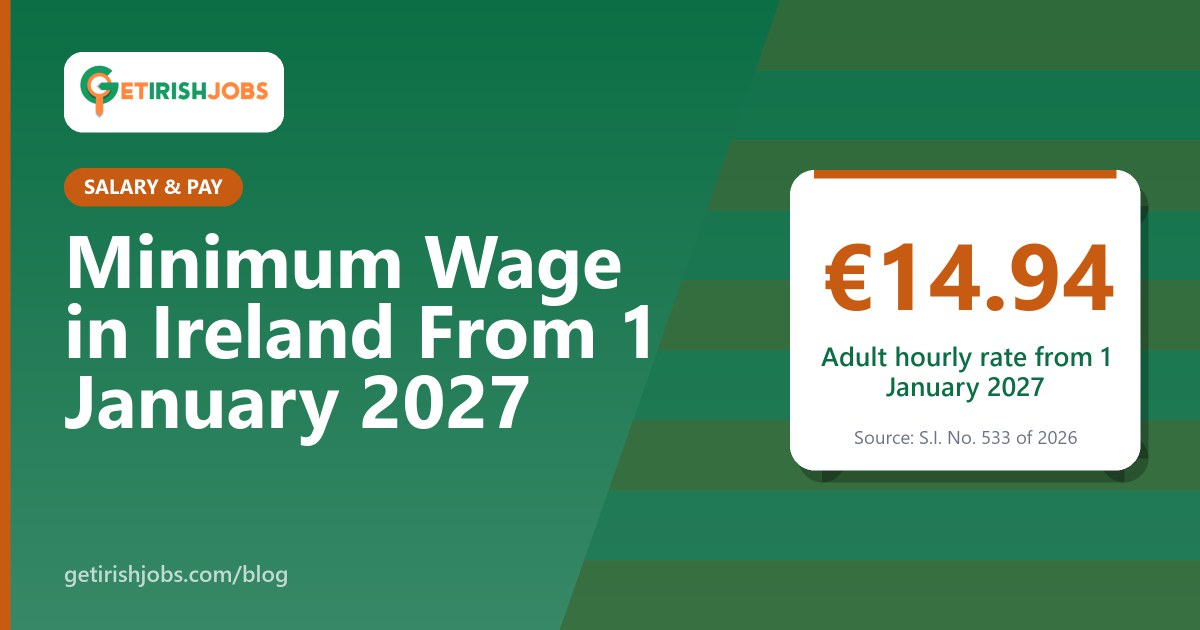
Table of contents
- What is the minimum wage in Ireland from 1 January 2027?
- How has the minimum wage changed in recent years?
- How much is the minimum wage per week and per year?
- Who does not get the minimum wage?
- What counts towards the minimum wage?
- What else changes for low-paid workers in January 2027?
- What should I do if I am paid less than the minimum wage?
- Does the minimum wage affect work permits?
- Where are minimum wage jobs?
- Sources
Last reviewed: 23 November 2026.
Short answer: the minimum wage in Ireland in 2027 is €14.94 an hour for workers aged 20 and over, from 1 January 2027. That is a rise of 79 cent (5.6%) on the 2026 rate of €14.15, and works out at about €582.66 a week or €30,298 a year for a 39-hour week. Workers under 20 can be paid a percentage of the adult rate.
The increase was announced in Budget 2027 on 6 October 2026, as the Low Pay Commission had recommended, and made law by the National Minimum Wage Order 2026 (S.I. No. 533 of 2026), signed on 15 October 2026. The order states that it comes into operation on 1 January 2027.
Key takeaways
- Adult rate from 1 January 2027: €14.94 an hour (was €14.15).
- Under-20s: 90% at 19, 80% at 18 and 70% under 18, so about €13.45, €11.95 and €10.46.
- Board and lodging that count towards the minimum also rise, to €1.34 an hour for board and €35.28 a week for lodgings.
- The USC 2% band rises to €30,300, so a full-time minimum wage worker stays out of the 3% band.
- Employment permit thresholds are separate and much higher: €36,605 for a General Employment Permit.
What is the minimum wage in Ireland from 1 January 2027?
| Age | Share of adult rate | 2026 | From 1 January 2027 |
|---|---|---|---|
| 20 and over | 100% | €14.15 | €14.94 |
| 19 | 90% | €12.74 | about €13.45 |
| 18 | 80% | €11.32 | about €11.95 |
| Under 18 | 70% | €9.91 | about €10.46 |
Adult rates: S.I. No. 533 of 2026 and Citizens Information. Youth rates are set as percentages of the adult rate by the National Minimum Wage Act 2000; the 2027 figures are those percentages of €14.94, rounded to the nearest cent.
The adult rate applies from your 20th birthday. An employer can pay more than these rates, and many do: the minimum is a floor, not a guide to what a job is worth. If you are 18 or 19 and doing the same job as older colleagues, it is worth asking whether the employer pays the adult rate anyway.
How has the minimum wage changed in recent years?
| From 1 January | Adult hourly rate | Increase |
|---|---|---|
| 2025 | €13.50 | |
| 2026 | €14.15 | 65 cent |
| 2027 | €14.94 | 79 cent |
The 2027 rise is the larger of the two. Over two years, a full-time worker's gross pay goes up by about €2,900 a year, from €27,378 at €13.50 to €30,298 at €14.94, before tax. The Low Pay Commission recommends a rate each summer, and the Government usually confirms it in the October Budget.
How much is the minimum wage per week and per year?
| Hours a week | Weekly pay at €14.94 | Yearly pay (52 weeks) |
|---|---|---|
| 20 | €298.80 | €15,538 |
| 30 | €448.20 | €23,306 |
| 39 (full-time) | €582.66 | €30,298 |
| 40 | €597.60 | €31,075 |
After income tax, USC and PRSI, a single full-time worker on the 2027 minimum wage takes home about €26,745 a year (roughly €2,229 a month), as worked out in our take-home pay guide for Budget 2027.
Who does not get the minimum wage?
Almost every employee is entitled to it, including part-time, temporary and casual workers, and people on work trials, internships and work experience placements. The exceptions are narrow: people employed by a close relative, such as a spouse or parent, and apprentices on statutory apprenticeships. Under-20s are covered, but at the lower youth rates above.
Some sectors have higher legal minimums set by Employment Regulation Orders, for example contract cleaning and security. Where one applies, you get the higher rate.
What counts towards the minimum wage?
Your average hourly pay over a pay reference period (up to one month) must reach the minimum. Basic pay, shift premiums, bonuses and commission count. Overtime premiums, unsocial hours premiums, premiums for Saturdays, Sundays and public holidays, on-call allowances and tips, including tips shared out through payroll, do not. Sick pay and holiday pay are not counted either.
If your employer gives you food or accommodation, a set amount can be counted as pay. From 1 January 2027, the order sets this at €1.34 an hour for board, and €35.28 a week or €5.04 a day for lodgings, up from €1.27, €33.42 and €4.77. This matters for hotel, restaurant and farm workers who live in.
What else changes for low-paid workers in January 2027?
- USC: the 2% band rises from €28,700 to €30,300, so the higher minimum wage does not push full-time workers into the 3% rate.
- Tax credits: the personal and employee tax credits each rise by €125 to €2,125.
- Employer PRSI: the weekly threshold for the higher employer rate rises from €552 to €600, so employers have no reason to cut a full-time minimum wage worker's hours.
The Government has also moved its planned switch to a living wage, set at 60% of median hourly earnings, from 2026 to 2029, as noted in the Low Pay Commission's 2026 report.
What should I do if I am paid less than the minimum wage?
- Check your payslip in January to see the new rate applied from your first hour worked in 2027.
- Ask for a written statement of your average hourly pay. Your employer must give it within four weeks.
- Raise it with your employer in writing. You are protected from being penalised for asking.
- Go to the Workplace Relations Commission (WRC) if it is not fixed. You can ask a WRC inspector to investigate, or refer a dispute to an adjudicator within six months of getting the statement.
Your employer also cannot cut your hours to avoid the increase unless your duties are reduced too.
Does the minimum wage affect work permits?
Not directly. Employment permits have their own salary thresholds: €36,605 for a General Employment Permit and €32,691 (at least €16.12 an hour) for healthcare assistants and home support workers, both well above the minimum wage.
Where are minimum wage jobs?
Entry-level jobs in retail, hotels and restaurants and customer service often start near the minimum. To earn more, compare offers with the average salary in Ireland, read our guide to job vacancies in Ireland, and build a strong CV with the free CV maker.
Sources
- S.I. No. 533 of 2026, National Minimum Wage Order 2026 (Irish Statute Book)
- Citizens Information, Minimum wage, and Budget 2027 summary
- Low Pay Commission, Recommendations for the National Minimum Wage, July 2026
- National Minimum Wage Act 2000 (youth rates)
- Workplace Relations Commission, national minimum wage (earlier rates and orders)